
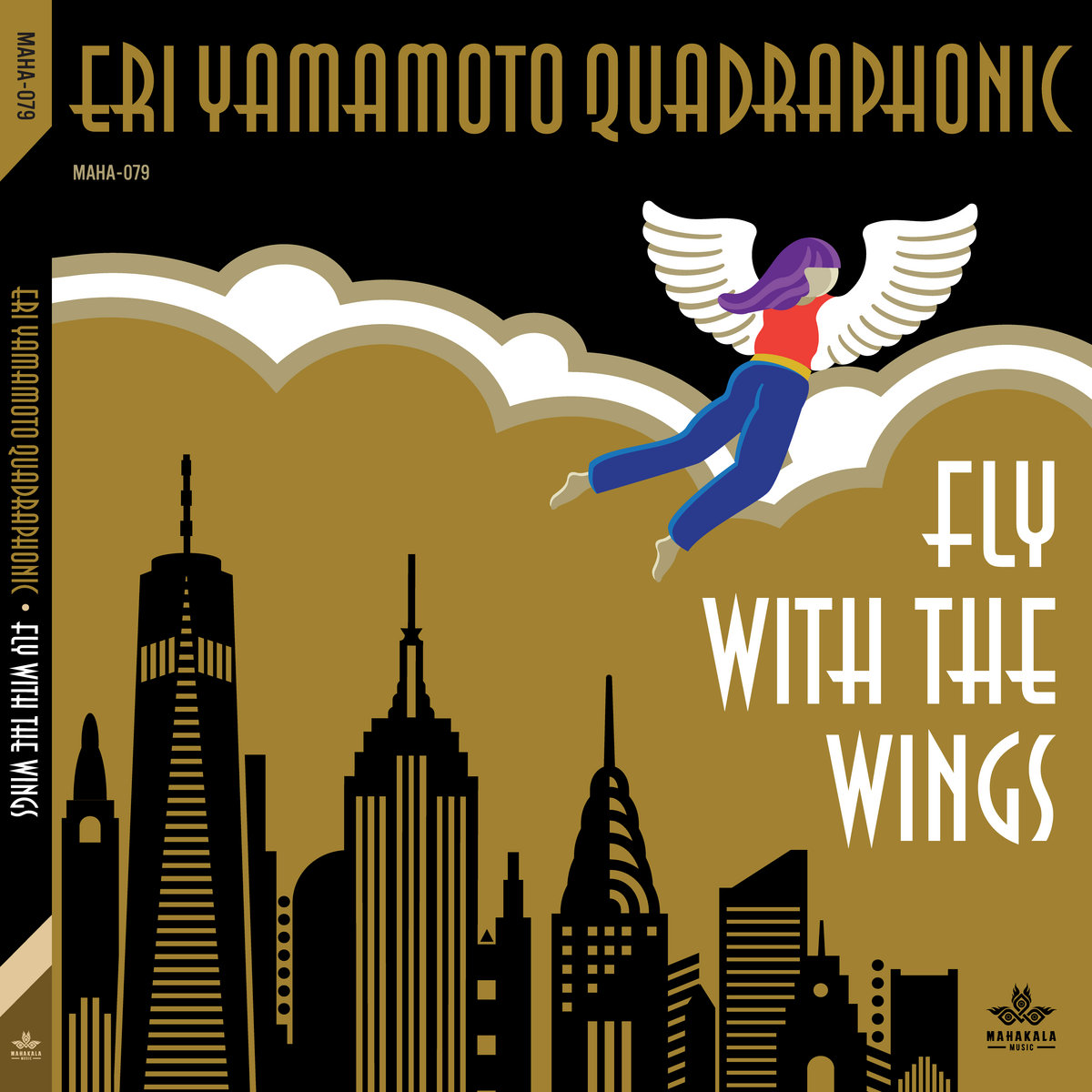
Fly With The Wings
Released 2024-10-04 · via artist page on Bandcamp
Tracks
- What Do They Mean 6:09
- Fly With The Wings 6:08
- Peach 5:53
- Cheer Me Up 7:21
- Where To Go 4:41
- Let's Do It 5:23
About
Quadraphonic: Eri Yamamoto’s Vision of Freedom (With a Shot of Rhythm & Blues).
Sometimes, a single sound can stir an entire vision. At least, that’s what the ever-inquisitive composer Eri Yamamoto heard in the tone of a saxophone one night, a note that sparked an imagined combo in her mind’s eye, a quartet of players she knew could play it loose, lyrical and groovy. As that group came to be, they created Yamamoto’s new album on Mahakala Music, Fly with the Wings.
Today, the Osaka-born pianist (who’s turned heads in New York for decades, working with the likes of Daniel Carter, Hamid Drake, Federico Ughi, Yves Leveille and Paul McCandless) recalls when that saxophone sound shot through her while she played with Sparks, a free improv group that also includes her longtime collaborator William Parker on bass, Chad Fowler on stritch and saxello (saxophones), and Steve Hirsh on drums. “It was all free, you know, with that band,” she says of Sparks, “but I could hear the influence of rhythm and blues, particularly in Chad's playing.”
Fowler, for his part, has long chased his vision of a Southern brand of free music touched with some of the lyricism and pulse of the blues. It comes out in much of his playing, whether he’s collaborating with Meshell Ndegeocello, Reggie Workman, Matthew Shipp, or others. And when Yamamoto heard, perhaps in a single blue note, all the implications of his tone, her creative spirit was galvanized. “I thought, wow, I love the groove and the sound! It’s so down to the earth, and it comes through, really deep in my soul. So I started writing. And the whole time, I was imagining Chad on alto sax, and Ikuo [Takeuchi] on drums, and Kevin Thomas on upright bass.”
Thomas, too, represented a certain earthiness to Yamamoto. “He's originally from Colorado, but he spent eight years or so in Las Vegas.” To this day, Thomas plays with A-list groups like The Doc Severinsen Big Band. “And that music has the blues and, of course, jazz, but it's very oriented to the groove. Simple, but with a really groovy bass line,” says Yamamoto. “So, I thought, ‘Wow, I want to do that.’”
To fully understand that sentiment, note that Yamamoto has gained much respect over the years for both her free and more straight-ahead recordings, blending multiple influences into her singular sound. As Herbie Hancock himself said, “My hat’s off to her... already she’s found her own voice.” Yet her voice hasn’t often included R&B influences to this degree.
While her horn and bass players were relatively new to Yamamoto, befitting a new direction, drummer Ikuo Takeuchi has been her comrade practically since she moved to New York. “I think we've been playing together for 28 years,” muses Yamamoto. “I met him at the New School.”
That was back when New School faculty member and bass virtuoso Reggie Workman gave her some advice. “One day, Reggie just knocked on the practice room and said, ‘You know, Eri, for your style, playing in a trio will be the best. Just stop practicing now and go out, walk around the school, and find a bassist and a drummer.’ So I put my ears to every single wall until I heard Ikuo, and I thought, ‘Wow, I like that.’ Ironically, he was Japanese too, but I didn't know he was Japanese at first — I just heard his drumming down the hall. So I asked him, ‘I'm gonna start my trio. Would you like to play with me?’ And he said, ‘Okay.’”
Yamamoto and Takeuchi have been musical collaborators ever since, often playing as a duo at Arthur’s Tavern and elsewhere. As the pianist pursued her vision for Quadraphonic, she knew her drummer could keep up. “He's very important part of my creativity,” says Yamamoto. “He takes time to understand each tune, and what's the best way to make that piece as one sound. He's not only a drummer; he really thinks about making the whole sound as a band, and that is very important.”
At home playing both structured and free jazz, like Yamamoto herself, Takeuchi was the perfect choice to help the composer strike a balance. “With this quartet, I wanted to go very free,” says Yamamoto. “That doesn't mean ‘free jazz,’ but I didn't want to be too strict. I definitely wanted to record in one room, and during the recording we said, ‘The form is such-and-such, but there is no form.’ The form could just happen with eye contact, and then the music told us where to go.”
The end result? Playful, groovy, swinging, and prone to unexpectedly ethereal, haunting passages. The grooviness is never too on-the-nose (and the song “Peach,” for instance, is a breathtakingly tender, wistful ballad). Sure, tracks like opener “What Do They Mean” come on like a classic blues waltz, perhaps an update on the classic Mose Alison approach, just as closer “Let’s Do It” touches on retro cinematic funk (featuring Yamamoto’s formidable melodica chops, no less). Then a skronk from Fowler’s alto will give the proceedings an off-kilter twist, or Yamamoto’s solo, untethered to any chordal pattern, will take flight into uncharted territory. That’s even more pronounced on the airy “Fly with the Wings,” its eerie unison melody giving way to the magic of four players simply making eye — and ear — contact. From there, the rest of the album works the territory between those two extremes.
Both the groove and the free playing befit Yamamoto’s overwhelming sense of possibility these days. It’s a stark contrast to the not-so-distant months of Covid-induced lockdown, a traumatic period that left Yamamoto feeling rattled, not least by the violence breaking out against Asian people at the time. That in turn was reflected in her music.
“If you look at the front cover of Fly with the Wings, I'm wearing a purple wig, right? That is linked to my previous trio album, A Woman with a Purple Wig. That purple wig was for hiding my ethnic identity from the violence during the pandemic and after. So on this new album, I'm still wearing purple wig, but now it's not hiding my identity,” Yamamoto smiles. “I'm wearing it for fun.”
Credits
Eri Yamamoto - piano, voice (tr. 1 & 5), melodica (tr. 6)
Chad Fowler - alto sax, flute (tr. 2)
Kevin Thomas - bass
Ikuo Takeuchi - drums
All compositions and lyrics composed by Eri Yamamoto
Recorded by Amadis Dunkel, Blue Frog Studio, NYC, May 3, 2024
Mixed and mastered by David Darlington, Bass Hit Studio, NYC
Produced by Eri Yamamoto and Chad Fowler
Cover art by Daniel Pelavin
Graphic design by Chad Anderson
Piano tuning by Kaz Tsujio